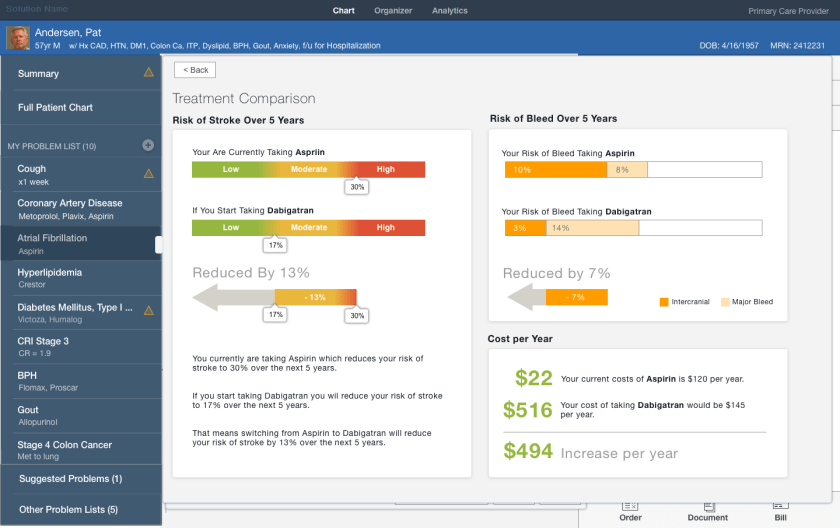
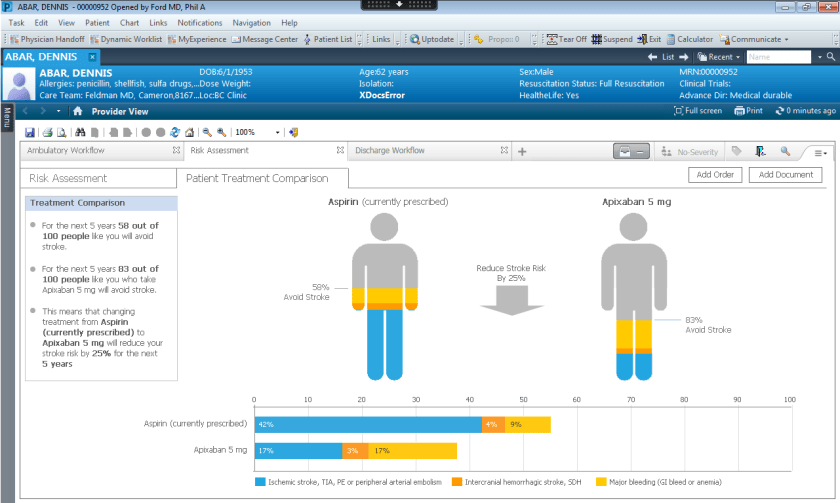
This project allowed a physician to assess a patient’s risk profile based on different treatment plans. This also included a patient facing overview that allowed the physician and patient to make a joint decision on the treatment plan.
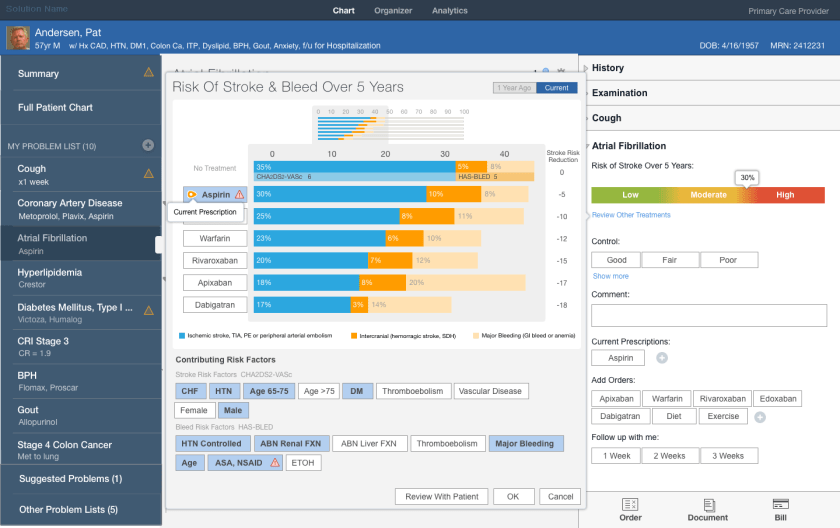
Presenting the data in a simplified graph was challenging because there were multiple levels of information that needed to be displayed simultaneously. First there was a need to quickly alert the physician if there was a need to investigate the patient’s risk further. So synthesizing the data into a simplified ‘heat bar’, which indicated the patient’s risk level, allowed the physician to quickly see if there was a problem.
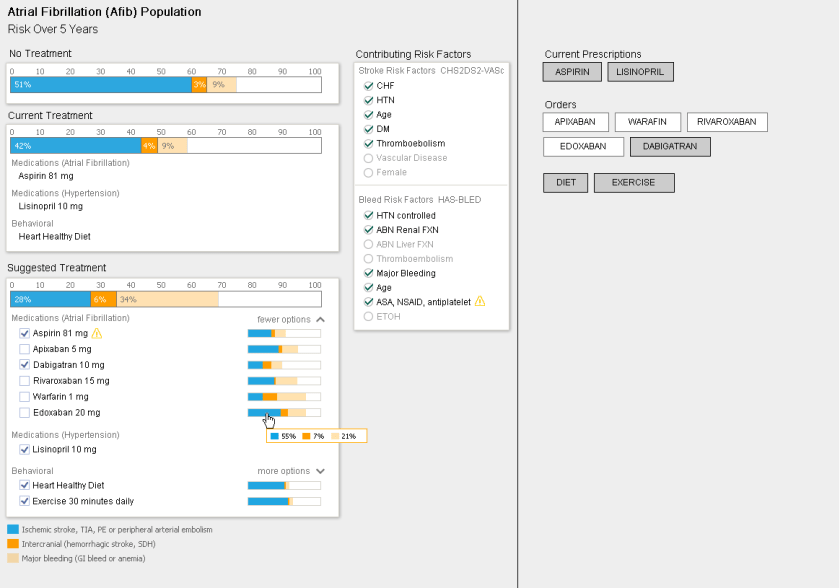
Then the physician could drill down further and assess the current risk levels based on ‘what if’ scenarios. The graph had to represent two different risk levels (stroke and bleeding) simultaneously. And the bleed risk had to be further broken down into minor or major bleed risk.
Along with those detailed risk levels, based on user feedback, it was also important to represent the CHA₂DS₂-VASc score as well as the HAS-BLED score. These scores were something that the physicians were familiar with and the graph allowed them to compare these scores against the more accurate percentage risk based levels.
It was also important to zoom in on the risk scores instead of displaying them on complete 1-100 graph, due to the importance of minute changes in the score. A small mini graph at the top displayed the complete 1-100 levels, while the larger zoomed in graph was displayed below.
 Mark Alexander